Most construction projects come with a clear window of time when the building is empty, the client steps back, and the contractor gets on with the work. Hospital refurbishment does not work like that. The building stays open. Patients continue to be treated. Clinical teams continue to work. And the contractor has to deliver a complex, technically demanding scope without any of that stopping.
It is one of the most challenging environments we work in, and one where the consequences of poor planning are not just commercial. They are clinical. That changes how every aspect of the project needs to be approached, from the first site survey through to handover.
What Hospital Refurbishment Actually Involves
Hospital refurbishment covers a wide range of work. At the smaller end, it might mean the refurbishment of a single ward, a patient waiting area, or a clinical support room. At the larger end, it could involve the full reconfiguration of a department, replacement of all mechanical and electrical infrastructure, upgrades to ventilation and medical gas systems, new flooring, ceilings, and wall finishes specified to healthcare standards, and full compliance with the infection control requirements that govern how healthcare spaces are built and maintained.
Whatever the scope, the fundamental challenge is the same. The work has to happen in a building that is in constant use, often around the clock, with clinical activity continuing immediately adjacent to the construction zone. That demands a level of planning, coordination, and site discipline that goes well beyond a standard commercial refurbishment.
Phasing and Decanting: Keeping Clinical Services Running
One of the most complex planning challenges in hospital refurbishment is working out how to phase the works so that clinical services can continue without interruption. Wards need to be decanted before they can be refurbished. Departments need temporary facilities while their permanent spaces are out of use. Critical services, theatres, intensive care units, emergency departments, cannot simply be closed down.
This requires close collaboration with the hospital’s estates and facilities team, clinical managers, and often the infection control department, from the very earliest stages of project planning. The programme needs to be built around what the hospital can accommodate operationally, not just what is most efficient from a construction perspective.
Phasing also has direct implications for cost and programme. A well-phased hospital refurbishment can often be delivered with minimal disruption and within a tightly managed timescale. A poorly phased one creates conflicts between clinical activity and construction, generates infection control incidents, and inevitably runs over programme and budget.
We plan phasing in detail before work starts on site. That means mapping out which areas need to be vacated and when, what temporary arrangements are needed, how clinical teams will be communicated with throughout, and what the contingency is if a phase runs into difficulty. Getting this right is one of the most important things a contractor can do on a healthcare project.
HTM Compliance and Technical Standards
Hospital buildings are subject to a comprehensive framework of technical standards that do not apply to most other building types. The NHS Health Technical Memoranda cover everything from ventilation and water systems to electrical infrastructure, medical gases, and fire safety. Refurbishment projects that touch any of these systems need to be designed and delivered in compliance with the relevant HTMs.
Ventilation is particularly important. Operating theatres, isolation rooms, and other specialist clinical spaces have very specific requirements for air change rates, pressure differentials, and particulate filtration. Replacing or modifying a ventilation system in a clinical area is not simply an M&E task. It requires a proper understanding of the clinical function of the space and the performance standards it needs to meet.
Equally, electrical systems in hospitals must meet the requirements for healthcare premises, including the provision of essential and critical power supplies that ensure clinical equipment continues to function in the event of a supply interruption. Any electrical works as part of a refurbishment need to be carefully integrated with existing systems and validated before the space returns to clinical use.
Working within this framework requires a contractor with genuine healthcare construction experience. It is not enough to have capable M&E subcontractors. The principal contractor needs to understand the standards well enough to manage the design, coordinate the trades, and ensure compliance is maintained throughout – not just at practical completion.
Managing Noise, Vibration, and Out-of-Hours Working
Construction noise and vibration in a hospital environment affects patients directly. For people who are unwell, in recovery, or in critical care, noise is not simply an inconvenience – it has a measurable impact on clinical outcomes and patient experience.
This means that certain types of work simply cannot happen during normal hours in certain areas. Breaking out concrete, core drilling, heavy mechanical work. These activities often need to be programmed into nights or weekends, when the adjacent clinical areas are at their quietest or temporarily vacated. Out-of-hours working adds cost and complexity to any programme, and it needs to be factored in honestly from the start rather than treated as an option of last resort.
Good communication with the clinical team is essential here. Ward managers and department heads need to know what is happening, when it is happening, and who to contact if something becomes a problem. A contractor who keeps clinical staff in the loop builds trust. One who does not creates friction that makes the whole project harder to deliver.
Why Experience in Healthcare Construction Matters
Delivering hospital refurbishment and healthcare construction well requires a very specific combination of technical knowledge and operational awareness. The technical side covers HTM compliance, infection control, M&E integration, and the structural and fabric requirements of clinical spaces. The operational side covers how hospitals actually work. The rhythms of a ward, the pressures on clinical staff, the way estates and facilities teams manage competing priorities across a large and complex estate.
Both of those things come from experience. A contractor who has delivered healthcare projects before knows what questions to ask, where the risks are, and how to manage the interfaces between construction and clinical activity in a way that protects both.
Healthcare Construction in Practice
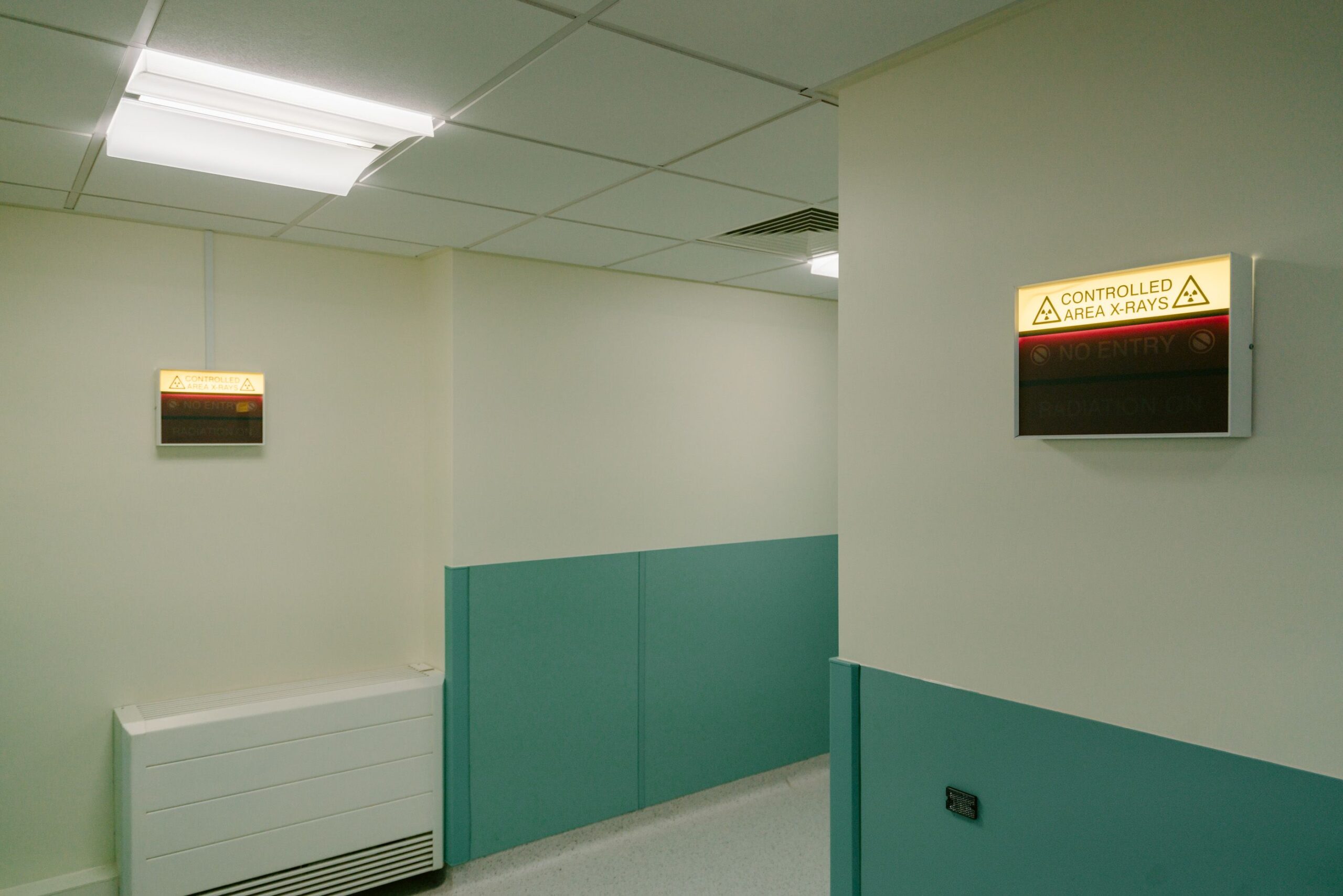
Our Pharmacy Unit project at South Tyneside Hospital for NHS Trust South Tyneside is a practical illustration of what that looks like on the ground. The project involved the part conversion of an existing pathology lab into a new robotic pharmacy facility, with all works carried out within a live hospital environment. Initial ceiling works were completed out of normal hours to allow temporary dust screens to be installed, maintaining full separation between the existing pathology lab and the new pharmacy space throughout. A new external double door access point was formed specifically to avoid construction personnel having to enter the hospital during the works, a decision that made a significant difference to infection control on site. The fit-out included major M&E alterations, new fire dampers, specialist gas services, scanner infrastructure, and a full new interior finish. Every element was coordinated and delivered without disruption to the adjacent clinical operation.
At Arcas, we bring over a decade of experience delivering construction projects across the health sector in the North East. We hold Constructionline Gold membership and CHAS Elite accreditation, the latter reflecting a commitment to health and safety management that goes above and beyond standard practice. In a hospital environment, that standard is not a differentiator. It is a requirement.
If you are planning a hospital refurbishment or any construction work within a healthcare setting and want to talk through what good delivery looks like, get in touch with the Arcas team today. Whether you have a detailed brief or you are still in the early planning stages, we will give you a straight answer on what is involved and how we would approach it.