School refurbishment is one of the most rewarding types of construction work we deliver, and one of the most demanding to plan properly. The buildings are often ageing and complex. The environment is sensitive. And the consequences of poor planning are felt not just by the client, but by the students and staff who use the space every single day.
If you are responsible for a school estate and considering a refurbishment programme, this guide covers what school refurbishment actually involves, the key planning considerations, and what to look for when appointing a contractor to deliver it.
What Does School Refurbishment Actually Involve?
School refurbishment is a broad term. At one end of the scale it might mean a single classroom refit or a toilet block upgrade. At the other, it could involve the full internal reconfiguration of a multi-storey building, replacement of the entire mechanical and electrical infrastructure, new windows and external cladding, and a complete overhaul of the building’s energy performance.
Most school refurbishment projects sit somewhere in between. Common scopes include roof replacement and weatherproofing, heating and ventilation upgrades, window and door replacement, internal redecoration and flooring, toilet and welfare refurbishments, specialist room upgrades such as science labs, design technology spaces, or sports facilities, and accessibility improvements to meet current building regulations.
Understanding the full scope before work starts is critical. Phased or incomplete scopes often cost more in the long run because work has to be redone or disrupted when the next phase arrives. A good contractor will help you think through the full picture at the outset, not just price what is in front of them.
The Unique Challenges of Refurbishing a School
Refurbishing a school is fundamentally different from refurbishing an office, a retail unit, or even a healthcare facility. The people who use the building are children and young people. That changes almost everything about how the project needs to be managed.
Safeguarding is the most important consideration. Any contractor working on a school site must have the right checks in place for all personnel, and must operate in a way that maintains safe, clearly defined separation between the construction zone and the areas where students are present. This is non-negotiable, and it is one of the first things we establish when we start planning a school project.
Beyond safeguarding, there is the question of noise and disruption. Construction activity generates dust, noise, and vehicle movements that have to be managed carefully in a live school environment. Deliveries need to be timed to avoid peak arrival and departure times. Dust containment needs to be properly specified. Hoarding and temporary screens need to be robust enough to prevent unauthorised access and visually separate the site from occupied areas.
Then there is the programme. Most schools cannot simply close for the duration of a refurbishment. Work often has to happen in phases, moving through the building as areas are vacated and reoccupied. That kind of phased delivery requires detailed planning, clear communication with school leadership, and a contractor who can adapt when the unexpected happens – because in a live school environment, it always does.
Term Time vs School Holidays: Planning the Programme
One of the most significant decisions in any school refurbishment is how to split the programme between term time and holiday periods. It affects cost, sequencing, and the level of disruption the school has to manage.
Holiday periods, particularly summer, offer the most productive windows for intrusive or noisy works. Structural alterations, M&E strip-out and replacement, floor finishes, and any work that generates significant dust or noise should ideally be programmed into holiday blocks where possible. Summer typically gives a six to seven week window, which can accommodate a substantial scope if the programme is tightly managed and materials are pre-ordered in advance.
Term time works are possible but need to be carefully scoped. Decoration, minor joinery, external works, and other low-disruption activities can often proceed during term time without significant impact on the school. The key is being honest about what can and cannot happen without affecting teaching.
We plan every school refurbishment programme around the academic calendar from the start. That means mapping out holiday windows, identifying which elements of the scope need those windows, and building a realistic sequence that protects the school’s operation while keeping the project on track.
DfE Standards and Building Regulations Compliance
School buildings in England must meet the requirements set out by the Department for Education, including Building Bulletin 103 (BB103) for acoustics and Building Bulletin 101 (BB101) for ventilation, thermal comfort, and air quality. Refurbishment projects that alter the building fabric or M&E systems need to consider these standards carefully.
Acoustic performance matters particularly in schools. Poor acoustics affect the ability of students to hear and process what is being taught, which has a direct impact on learning outcomes. Research published by the Education Endowment Foundation consistently highlights the importance of classroom environment on attainment. A refurbishment that improves the physical fabric of a school but ignores acoustic performance is not doing its job fully.
Ventilation is equally important, particularly following increased awareness of indoor air quality in educational settings. BB101 sets out clear guidance on fresh air provision, CO2 levels, and thermal comfort. Any M&E upgrade as part of a school refurbishment should be designed to meet or exceed these benchmarks.
Working within these standards requires a contractor and design team who understand the education sector specifically. It is not enough to know how to build, you need to know what you are building to.
Why Sector Experience Matters When Appointing a Contractor
School refurbishment requires a very specific combination of construction competence and sector awareness. A contractor who is technically capable but has no experience working in live educational environments will struggle with the safeguarding requirements, the phasing demands, and the communication expectations that come with a school client.
Equally, a contractor who has delivered plenty of school projects but lacks the technical depth to manage a complex M&E upgrade or a structural alteration properly will create problems of a different kind.
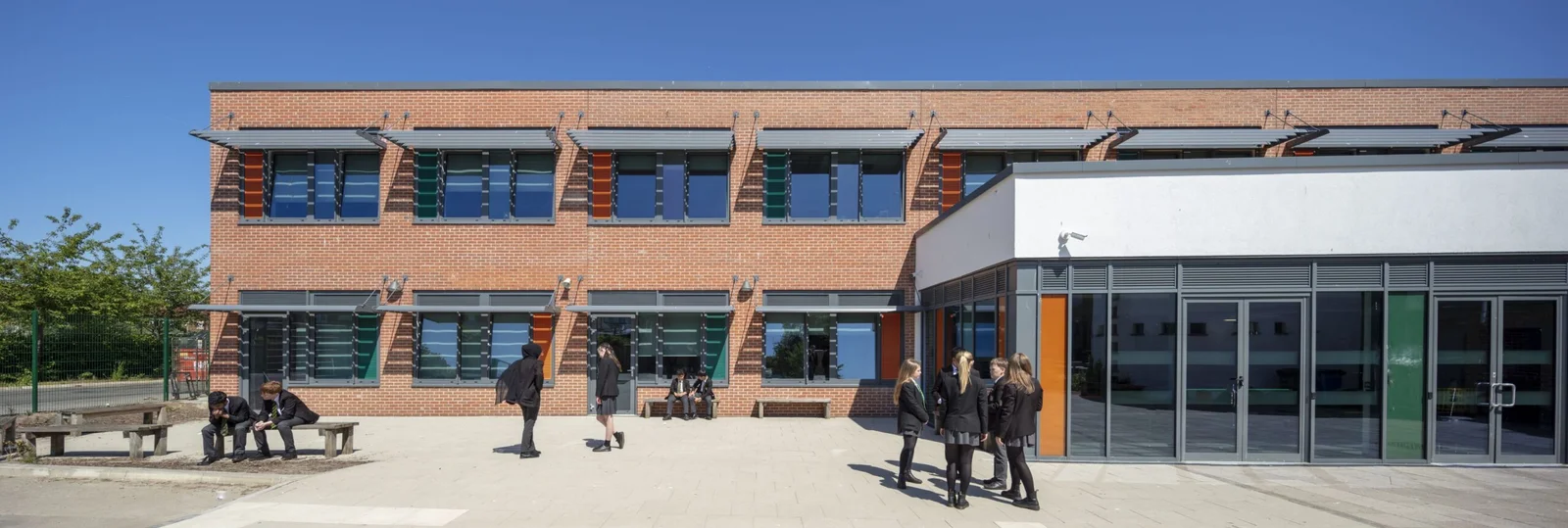
At Arcas, our education sector construction work spans primary, secondary, and higher education. Our refurbishment and extension project at St Wilfrid’s RC College in South Shields is a good example of what that looks like in practice. The £3.32m scheme involved the full internal modernisation of the existing Science and Art/Technology wing alongside the construction of a new two-storey teaching block. The programme was carefully phased to ensure internal refurbishment works were completed during the summer break, while demolition and foundation works for the new build element ran in parallel – minimising disruption to the college and its pupils throughout. We understand the compliance requirements, the sensitivity of the environment, and the importance of keeping school leadership informed and in control throughout the process. That combination of technical capability and sector knowledge is what makes a school refurbishment run smoothly.
We hold Constructionline Gold membership and CHAS Elite accreditation, both of which reflect the rigour we apply to health and safety management on every project. In a school environment, that rigour is not optional, it is the baseline.
What Good Planning Looks Like in Practice
The difference between a well-planned school refurbishment and a poorly planned one is usually visible within the first few weeks on site. Good planning means the programme is understood by everyone, materials are on site when they need to be, the school knows exactly what to expect and when, and the contractor is managing risks proactively rather than reactively.
It starts before a spade goes in the ground. A thorough pre-construction phase, covering surveys, design coordination, specialist subcontractor procurement, and programme development, sets the conditions for a successful delivery. Cutting corners at this stage to save time almost always costs more later.
Our approach to new build and refurbishment projects follows the same structured process regardless of sector: understand the brief fully, plan the delivery carefully, communicate clearly with the client, and manage the site with discipline. In a school setting, that structure is what protects the project and the people in it.
If you are planning a school refurbishment and want to talk through the scope, programme, or what appointing the right contractor looks like, get in touch with the Arcas team today. Whether you have a fully developed brief or you are still working out where to start, we will give you a straight answer on what is achievable.